The Wood-Woven Wonder: An Automotive Icon Re-envisioned for 2026
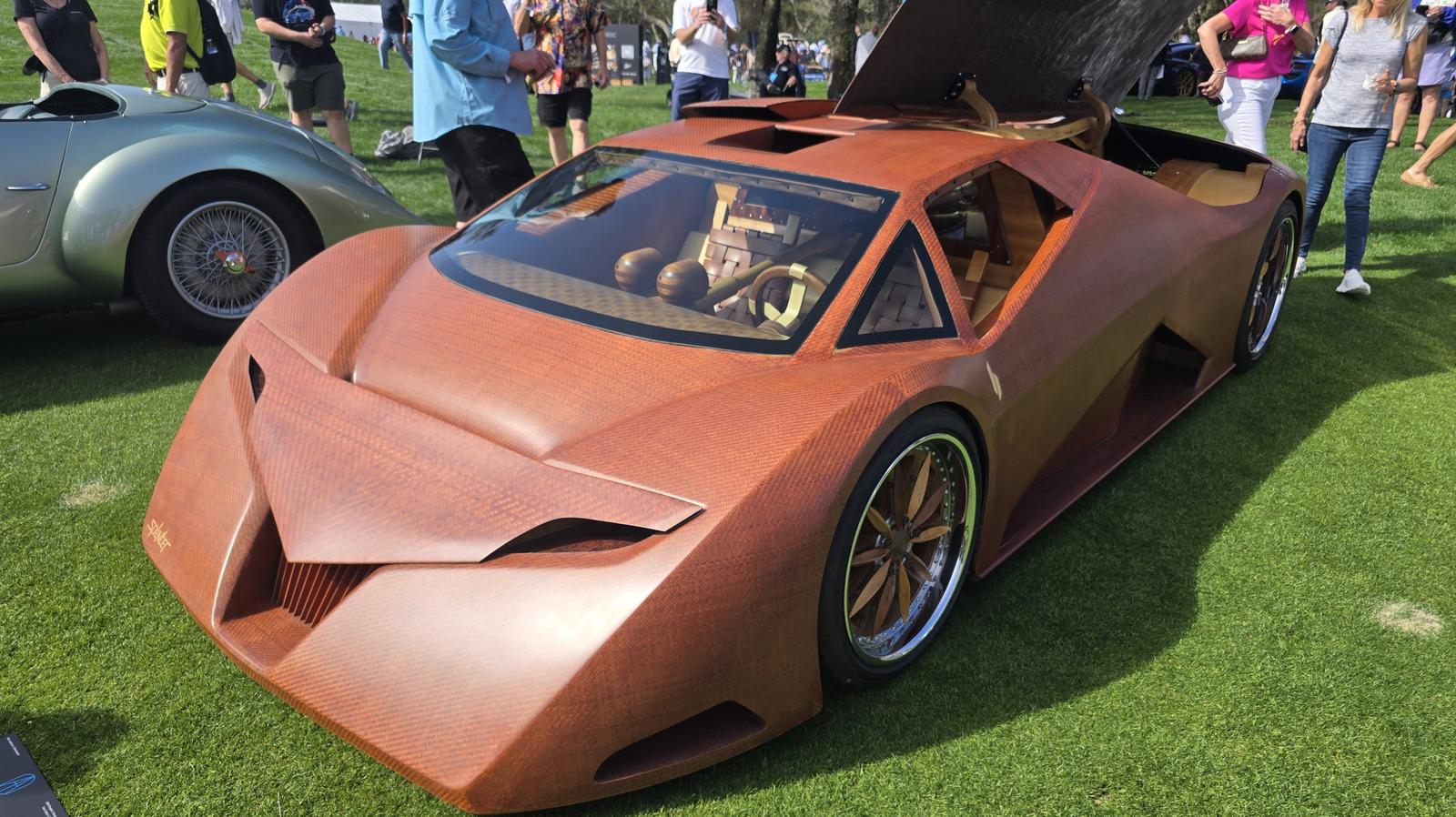
2026 Joe Harmon Splinter Wooden Supercar: The World’s Most Unique Drivable Masterpiece
Image: 2026 Joe Harmon Splinter Wooden Supercar: The World’s Most Unique Drivable Masterpiece – Performance and Specifications
- Advertisement -
Imagine a car that doesn’t just roll off an assembly line but is essentially grown. The 2026 legacy of the Joe Harmon Splinter remains the most audacious experiment in automotive history. While modern supercars chase carbon fiber and titanium, the Splinter takes us back to nature with a twist of high-performance engineering. The estimated value of this one-off masterpiece in 2026 is upwards of $250,000 (USD) in build costs alone, though its auction potential is effectively priceless.
The Splinter is not a kit car or a novelty; it is a high-speed, mid-engine sports car where the chassis, body, and even the wheels are crafted from wood. In a world of mass-produced EVs, the Splinter stands as a testament to craftsmanship and material science, proving that ‘organic’ and ‘supercar’ are not mutually exclusive terms.
- Advertisement -
The Engineering Marvel: Why Wood in 2026?
Material Science: More Than Just Lumber
Many critics originally dismissed the Splinter as a fire hazard or a slow-moving boat, but Joe Harmon’s 2026 legacy updates prove otherwise. Wood has a better strength-to-weight ratio than steel or aluminum when utilized correctly. The car uses a series of bent-wood laminates, utilizing maple, birch, and hickory to create a composite structure that rivals the rigidity of modern monocoques.
Aerodynamics and Aesthetic Prowess
The 2026 profile of the Splinter remains low-slung and aggressive. Every curve is hand-sculpted. The wood grain is not a wrap; it is the actual structural skin of the vehicle, finished with high-UV-resistant epoxy resins to prevent warping or rot in extreme climates. The air intakes are strategically integrated into the rear haunches to feed the massive V8 cooling system.
Performance: The Heart of the Splinter
The Powerplant: 700HP Northstar V8
Under the wooden rear deck lid sits a highly modified 4.6-liter Cadillac Northstar V8. For the 2026 spec, this engine has been tuned with twin superchargers to produce a staggering 700 horsepower. This power is sent to the rear wheels via a six-speed manual transaxle, making it a purist’s dream.
- Advertisement -
Suspension and Custom Wood Wheels
The suspension consists of upper and lower A-arms made of laminated wood, supported by adjustable coil-overs. Perhaps most impressively, the wheels are three-piece designs with a rotary-sliced oak veneer face, tested to withstand the lateral G-forces of a modern track day.
Interior Tech and Safety
The Cockpit: A Woodworker’s Dream
Inside, the Splinter is a masterclass in minimalism. There are no plastic dashboards here. Instead, you find woven cherry and walnut veneers. The 2026 updates include a hidden digital instrument cluster that emerges from the wood grain only when the ignition is engaged. The seats are molded to the chassis, providing a raw, connected driving experience.
Safety and NCAP Ratings
As a one-off experimental vehicle, the Splinter does not have an official Euro NCAP or Global NCAP rating. However, the use of laminated wood provides unique energy-absorption properties. In the event of an impact, the wood fibers are designed to splinter and dissipate energy, much like a carbon fiber tub, though the car lacks modern ADAS (Advanced Driver Assistance Systems).
- Advertisement -
The 2026 Rivalry: The Splinter vs. The Icons
In the niche world of lightweight, bespoke driving machines, the Splinter faces stiff competition from heritage brands and high-tech minimalist track cars.
| Feature | Joe Harmon Splinter (2026) | Morgan Plus Six (2026) | BAC Mono R |
|---|---|---|---|
| Primary Material | Laminated Wood Composite | Aluminum/Ash Wood Frame | Graphene-enhanced Carbon |
| Horsepower | 700 HP | 335 HP | 342 HP |
| Weight | 1,134 kg | 1,075 kg | 555 kg |
| 0-100 km/h | 3.6 Seconds | 4.2 Seconds | 2.5 Seconds |
| Transmission | 6-Speed Manual | 8-Speed Automatic | 6-Speed Sequential |
Full Technical Specifications
| Specification | Details |
|---|---|
| Engine Type | 4.6L Twin-Supercharged V8 |
| Max Power | 700 HP @ 6,800 RPM |
| Max Torque | 580 lb-ft |
| Top Speed | 386 km/h (Projected) |
| Chassis Type | Wood-based Monocoque |
| Brakes | 6-Piston Performance Calipers |
| Fuel Type | Petrol (High Octane) |
- Advertisement -
Estimated Market Value (2026)
| Variant/Status | Estimated Price (Ex-Showroom) |
|---|---|
| Original One-Off Build | $500,000+ (Auction Est.) |
| Component Cost | $250,000 |
| 2026 Modernized Refit | $320,000 |
People Also Ask (FAQ)
- Is the Splinter car actually drivable? Yes, it is a fully functional, mid-engine sports car designed to be driven.
- Does the wood catch fire from the engine heat? No, the engine bay is lined with advanced heat-shielding materials and thermal foils.
- How fast can the Splinter go? The theoretical top speed is 240 mph (386 km/h).
- Is it street legal? In most jurisdictions, it is registered as a custom-built or experimental vehicle.
- What kind of wood is used? It uses a mix of Maple, Birch, Hickory, and Cherry.
- Does the wood rot over time? No, the exterior is sealed with high-grade marine epoxy and clear coat.
- How many Splinter cars were made? There is currently only one original Splinter in existence.
- What engine does it use? A modified 4.6L Cadillac Northstar V8.
- Who built the Splinter? It was designed and built by Joe Harmon and his team.
- How much did it cost to build? Estimates suggest over $250,000 in materials and thousands of man-hours.
Verdict: Should You Buy It?
The Splinter is not a car you buy for a daily commute; it is a piece of rolling art you acquire for a legacy collection. It challenges the very definition of what a car can be. If you value craftsmanship over mass-market convenience, the Splinter is peerless.
Pros:
– Completely unique wooden construction.
– Incredible power-to-weight ratio.
– A guaranteed head-turner at any Concours event.
– Organic aesthetic that ages beautifully.
- Advertisement -
Cons:
– Lacks modern safety features (No Airbags/ABS).
– High maintenance for the wood finish.
– One-off parts make repairs difficult.
– Limited cabin space and tech.